|
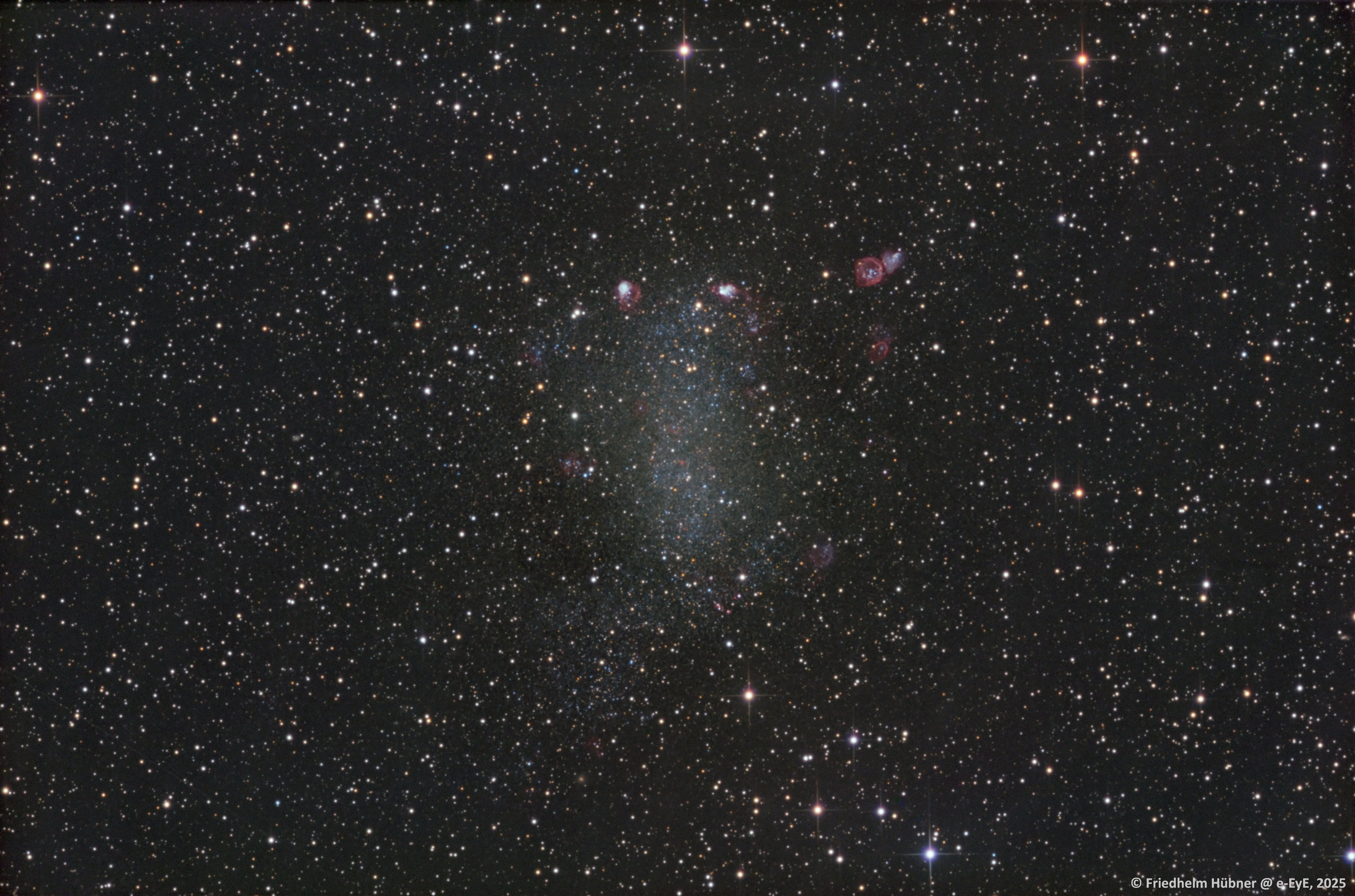
NGC 6822 (Sgr)
Click on the image for a larger version
| Date/Site: |
1., 3., 15., 20. August and 14. September 2025, e-EyE |
Exposure/
Filter: |
R: 41 x 180 seconds,
G: 39 x 180 seconds,
B: 31 x 180 seconds,
L: 49 x 300 seconds,
Hα: 18 x 300 seconds,
O3: 19 x 300 seconds (-5°C) |
Camera/
Optics/
Instrument: |
ASI 2600MM Pro with Astronomik Type 2c-filters on 400mm f/5 Newton with 2" TS Comacorrector on AP1200 GTO |
|
Data acquired remotely using N.I.N.A.,
Off-Axis-Guiding with ASI120,
Focusing with Microtouch,
Calibration with MaximDL 6, processing in PixInsight 1.8 using BXT and GraXpert |
NGC 6822, also known as Barnard's Galaxy, is an irregular dwarf galaxy belonging to the Local Group. It exhibits a large number of star-forming regions, but also many luminous gas bubbles, the remnants of stellar explosions.
Since the White Elephant telescope increasingly suffered from vibrations in declination near the zenith, even in light winds, I switched to imaging objects further south, hoping that the air would flow over the lowered telescope tube. In this case, it worked quite well.
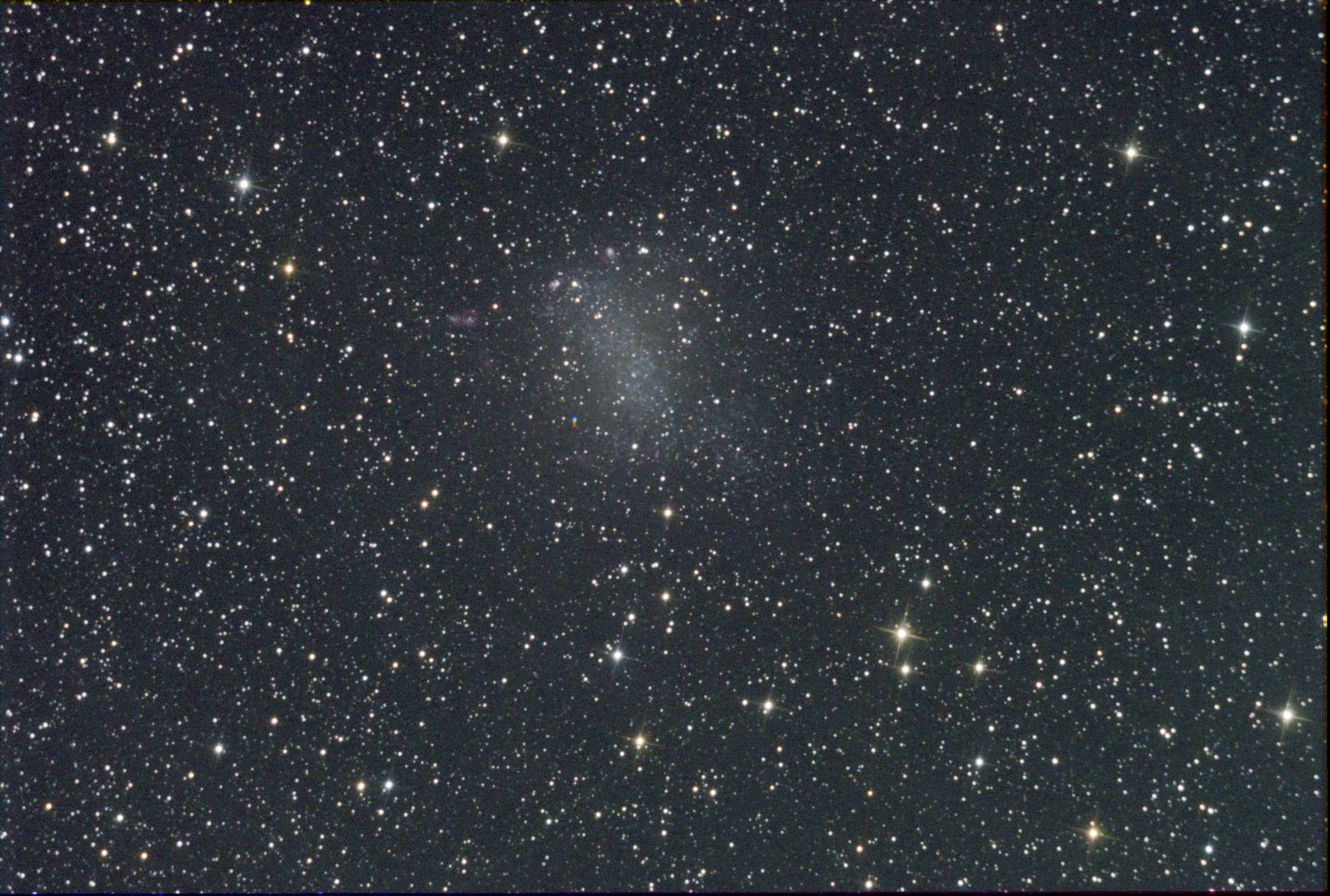
Several years earlier, I had already photographed this object from a beautiful location:
NGC 6822 (Sgr)
Click on the image for a larger version
| Date/Site: |
August 24th, 2011, Rifugio Monte Muro, Maurerberg, Southern Tyrol |
Exposure/
Filter: |
R: 3 x 600 seconds, G: 3 x 600 seconds, B: 3 x 600 seconds (-15°C) |
| Camera: |
SBIG ST10XME, CFW9 with SBIG LRGB-filters, AO-8 |
Optics/
Instrument: |
6"-Newton on Gemini 41 Observatory mount, RCC1 Coma-corrector |
|
Focusing with Robofocus |
|
Calibration, alignment and stacking: MaximDL 5.01,
Levels and curves: Photoshop CS |
Minor planet (689) Zita at 14.4 mag crossed the galaxy during the exposures.
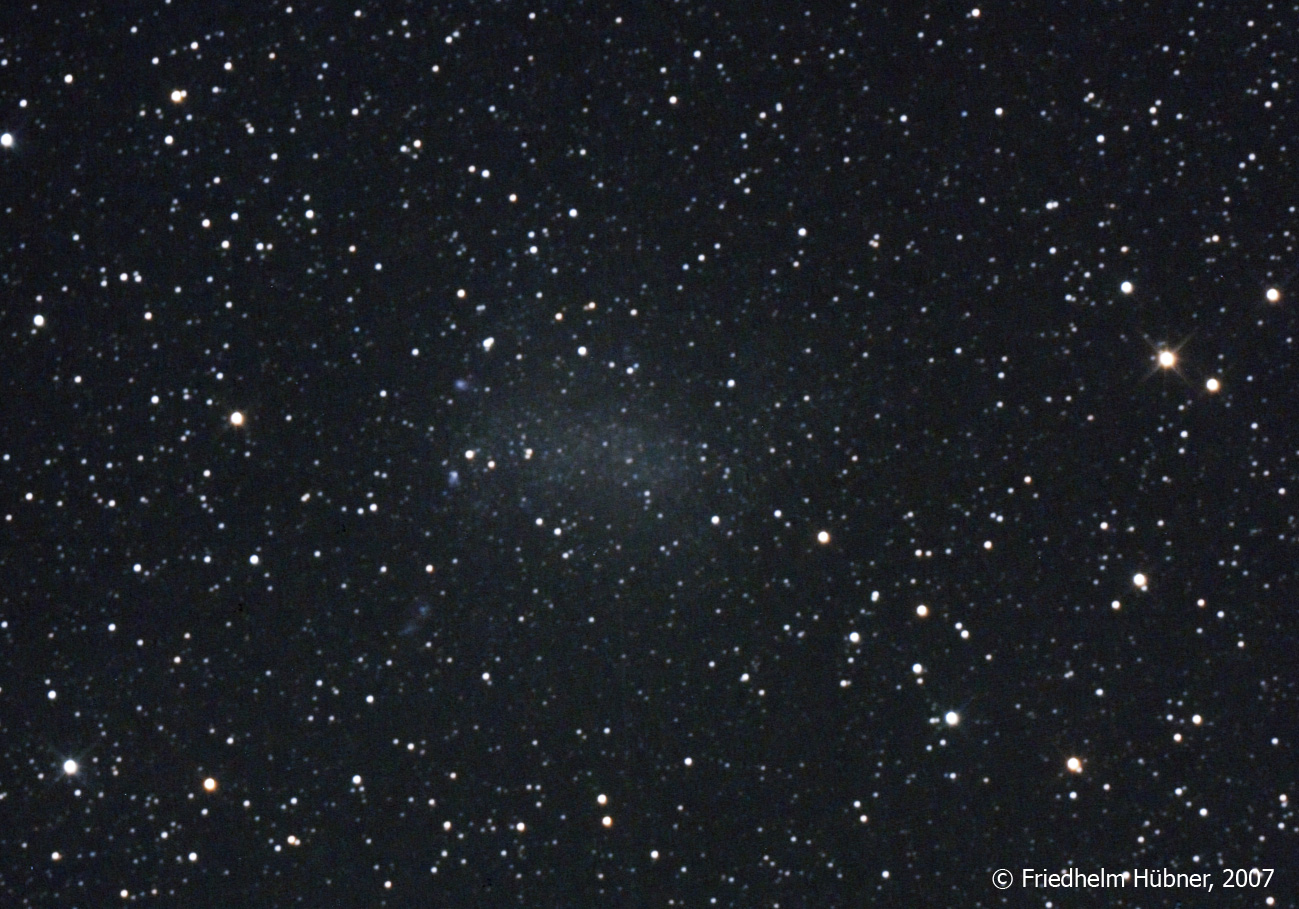
Compare this view with the shot with my Canon 350Da from the same location, only some years earlier:
NGC 6822, Barnard's Galaxy (Sgr)
Click on the image for a larger version
| Date/Site: |
September 13th, 2007, Rifugio Monte Muro, Maurerberg, Southern Tyrol |
Exposure/
Filter: |
10 x 6 minutes |
| Camera: |
Canon EOS 300Da |
Optics/
Instrument: |
6"-Newton on Gemini 41 Observatory mount, Baader-coma-corrector |
|
Focusing with RoboFocus and DSLR Focus
webcam-guiding with MaximDSLR through 4"-FH-refractor
Darks: Fitswork,
aligning and stacking: MaximDSLR,
levels and curves: Photoshop CS |
|